
Independent editorial guidance on compatibility, device settings, safety, and responsible use.
Troubleshooting server messages, black screens and stalled playback
Independent editorial guidance on compatibility, device settings, safety, and responsible use.
Readers who search for “Filmyzilla Fora do Ar ou Tela Preta? Como Resolver Erros Comuns” may see the same symptom described as an outage, a device fault or a problem with one film. A dark screen gives very little information on its own. Start by identifying what still works and where the failure begins. That helps you choose checks that can actually narrow the cause, while keeping your device settings and local viewing data intact.
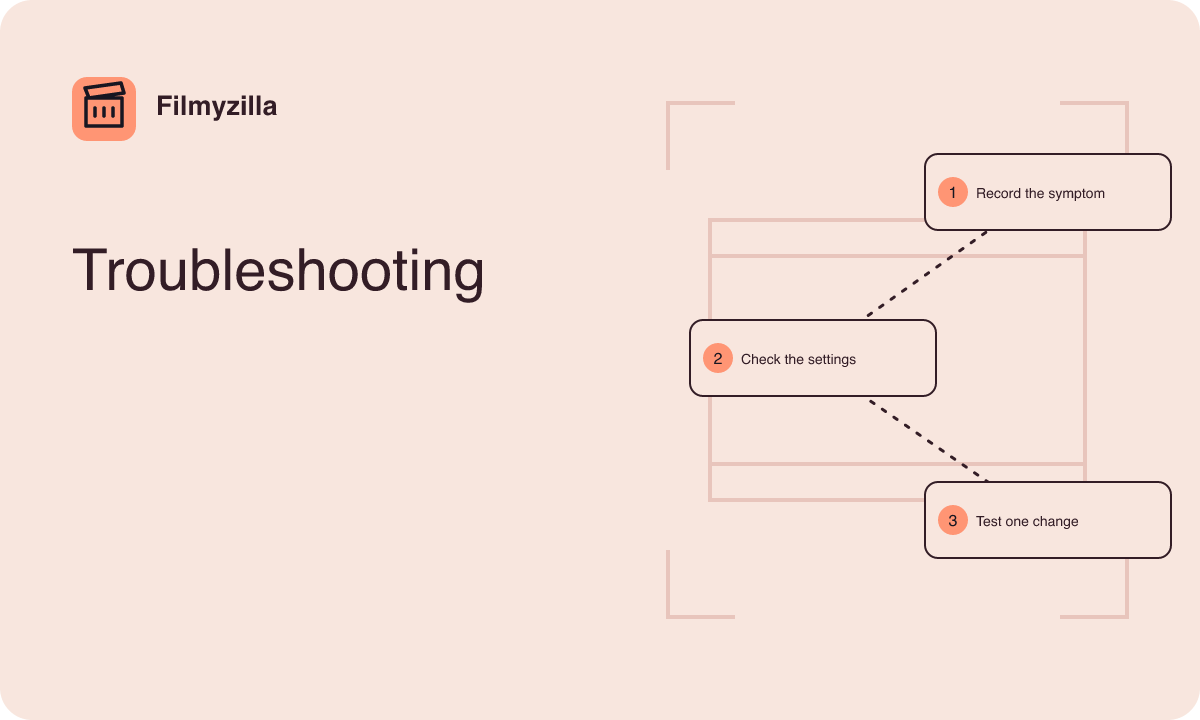
Describe what was on screen before the problem
Write down the action immediately before the error. Did you open the app, pick a film, resume a saved point or switch the audio track? Note whether menus or subtitles are visible on the dark screen. If you hear dialogue, the player may be doing something different from one that never starts. If a message appears, copy the wording in plain text and leave out any account or device identifiers it contains.
Include the time and your local time zone. A support team may use a different clock, and a brief outage can be hard to compare with a report that says only “today”. If you can safely repeat the action once, note whether it fails at the same stage. Repeatedly reopening the player without changing anything gives you little new information.
Work out how widely the failure occurs
- Try another authorised title in the same service, using the same device and connection. If only the first title fails, record its name and the point where it stops.
- Play an authorised video through a different provider on the same device. If both stall, look for a common factor such as network quality, audio routing or display settings.
- If the original provider documents support for another device you already use, compare the same title there. Check whether the other device is on the same connection.
- If the verified provider publishes service status or announcements, compare the symptoms and time with what it reports. Leave the cause open if the provider gives no confirmation.
A friend receiving the same error may be useful context if you both know which service you opened. Two pages with similar names may be unrelated. Avoid relying on outage claims that point you to an alternate domain or patched file. You can check local playback symptoms without installing a second app.
Follow the black screen symptom
If the device home screen is visible, open the player normally and see whether its controls appear. A picture that goes dark only after pressing play is different from a screen that goes dark at the HDMI input before you can navigate. On a TV with an external box, switch to an ordinary television menu to see whether the panel itself still displays an image. Then return to the intended input.
Try the same authorised title on the device's built-in display if the issue appears only when casting or connecting a second screen. If the direct display works, check the provider's guidance for the external display method. Protected playback can have specific requirements. Respect the supported methods when the provider or platform limits screen sharing. If the TV menus themselves go dark or repeatedly flicker, describe that to device support separately from the playback problem.
Check the connection without resetting the household
Open the network settings on the affected device and check which network it actually uses. A phone may switch to mobile data while a television remains on Wi-Fi. Compare short playback tests from the location where the problem happens. If a large download is already running on a device you control, pause it briefly and retest. Consider other household members before restarting shared equipment.
Try a lower quality setting if the authorised player offers one. If the same scene now plays smoothly, record the difference without treating it as proof of an outage. If everything on the device is loading slowly, check a second device on the same network. A device that improves near the router gives you a reason to investigate coverage. One that fails on a strong connection while other devices work may need app or device support instead.
Recover locally in a reversible order
Close the app using the device's ordinary controls and reopen it. If it still fails, restart the affected device when doing so will not interrupt someone else's work. Check the available space in device settings and see whether the verified store shows a relevant update. Skip removal or a reinstall if you cannot identify a source from which you could restore the app.
Some Android devices offer separate controls for clearing cache and clearing storage. Read the labels carefully. Clearing storage can remove preferences and saved viewing data, depending on the app. A service's own offline management screen may help you see what you risk losing. If a first restart or a setting change fixes things, record that result and leave the other settings alone. It is easier to identify the recovery when the changes are limited.
Know when to send a support question
For a repeatable failure, prepare a short note with the model, operating system, verified app version if visible and the single action that triggers the problem. Add what you compared and the result. A useful example would say that an authorised title has sound with a black picture on an external box, another title works on the same box, and the first title plays on a supported phone. Those observations point to a narrower question than “the server is down”.
Use a support route you can confirm through the provider or device maker. If you need to show a screenshot, crop out viewing profiles, account details and notifications. For a shared connection problem, include whether nearby devices were affected, while leaving out router identifiers and household information. If the provider has no verifiable contact and the failure remains unexplained, use the observations to guide your choice of another authorised way to watch. Before testing again later, keep the title and time handy so you can compare the same case.
If the fault appears when you resume a film from an old position, try starting the title from the beginning once. Record whether it loads there and whether seeking back to the original point causes the same fault. That distinction can help support investigate the report.